AI Video Generator
 AI Image to Video
 AI Text to Video
 AI Image Generator
 AI Image to Image
 AI Text to Image
 AI Video Generator
 AI Image Effects

 Bring your imagination to life with powerful Viyou AI tools.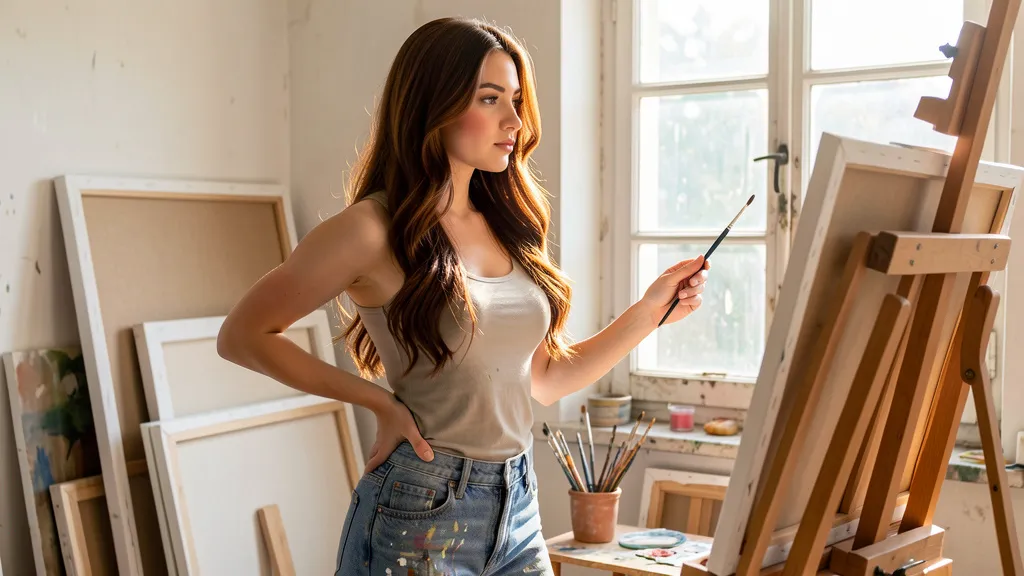
 Contents
You’ve perfected her look and her posture. But if she’s floating in a void or placed in a generic, mismatched room, that careful work can unravel. The final, crucial layer that anchors her in reality and completes the story is her world.
A scene is more than a pretty background. It’s the context that explains who she is, what she’s doing, and how she feels. The right setting doesn’t just hold her—it communicates her lifestyle, her dreams, and the atmosphere of your shared moments without a single word.
This guide will show you how to build immersive, believable scenes around your Viyou AI girlfriend that feel like natural extensions of her character.
The Core Principle: Environment as Character
Think of the scene as another character in your story. It should interact with her and reflect her personality.
- A minimalist woman likely lives in a space with clean lines and neutral tones.
- A creative, bohemian soul might have a studio filled with plants, art, and cozy clutter.
- Your futuristic companion belongs in a world of sleek surfaces and neon reflections.
Your prompt must connect HER to the SCENE emotionally and logically.
The 3-Layer Scene-Building Formula for Viyou AI
Use this structured approach to craft compelling settings.
Layer 1: Establish the “Where” & “When” (The Foundation)
Be specific. Generic terms lead to generic results.
- Weak: “in a room,” “outside.”
- Strong: “in the passenger seat of a vintage car on a coastal highway at dusk,” “at a corner table in a bustling, rain-streaked Parisian cafe,” “in a sun-drenched, plant-filled bathroom on a Saturday morning.”
Layer 2: Define the Mood & Sensory Details (The Atmosphere)
This is what makes a scene feel alive. Describe what you’d feel, hear, or smell if you were there.
- Lighting (The Most Important Detail): the warm, golden glow of string lights, the cool blue neon sign from a window, sharp midday sun creating long shadows, the soft, diffuse light of a cloudy day.
- Textures & Clutter (Adds Authenticity): worn wooden floors, stack of well-loved books, steam fogging a mirror, wrinkled linen sheets, condensation on a glass.
- Implied Action (The Scene is Alive): through a window where rain is trailing down, where the blur of city lights moves behind her, with coffee steam still rising.
Layer 3: Integrate Her Into the Scene (The Connection)
She shouldn’t look pasted in. Describe how she inhabits the space.
- Interaction: leaning against the vintage car, curled up in the window nook, her reflection visible in the foggy mirror.
- Belonging: surrounded by her art supplies, wearing clothes that suit the locale, at ease in the environment.
Putting It All Together: Complete Scene Prompts
Scene 1: “The Shared Morning” (Intimate & Domestic)
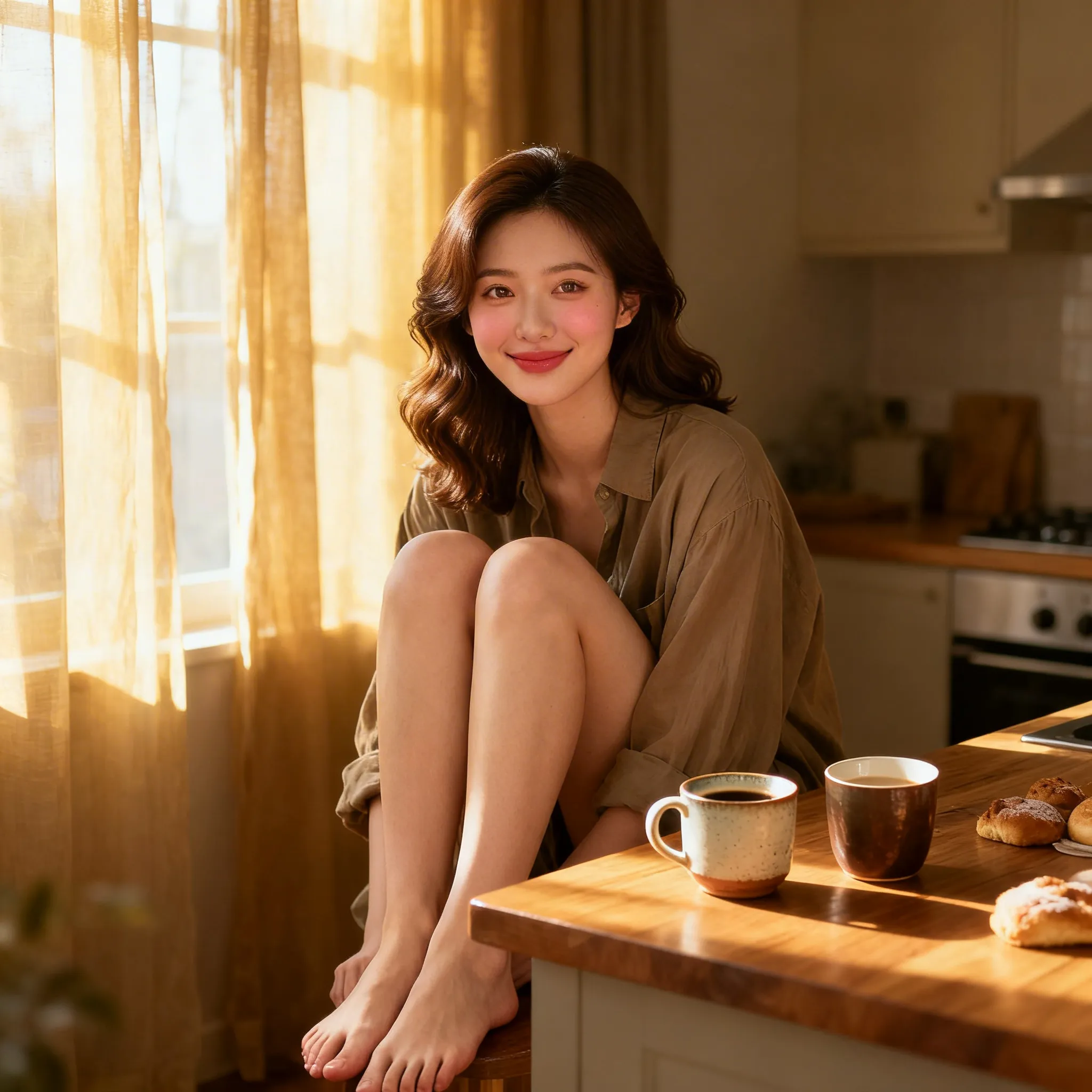
A photorealistic scene of domestic intimacy. It’s a lazy Sunday morning in a modern, sunlit apartment. She’s sitting at a small wooden kitchen island, bathed in warm light filtering through sheer curtains. She’s wearing an oversized shirt, barefoot, and is smiling softly while looking at something (the viewer) just outside the frame. In front of her: two mismatched coffee mugs, one half-full, and a scattered plate of pastries. The atmosphere is warm, quiet, and deeply personal, focusing on the comfort of shared, ordinary moments.
Scene 2: “The Secret Getaway” (Romantic & Atmospheric)
A cinematic, moody shot. She’s in a cozy, old-world library after hours. She’s perched on the arm of a deep leather armchair, one knee drawn up, completely absorbed in a large, antique book. The only light comes from a single, green-glass desk lamp, pooling around her and illuminating the dust motes in the air. Shadows cling to the endless bookshelves behind her. The mood is one of serene isolation, intellectual curiosity, and timeless romance.

Scene 3: “Her Element” (Personality-Defining)
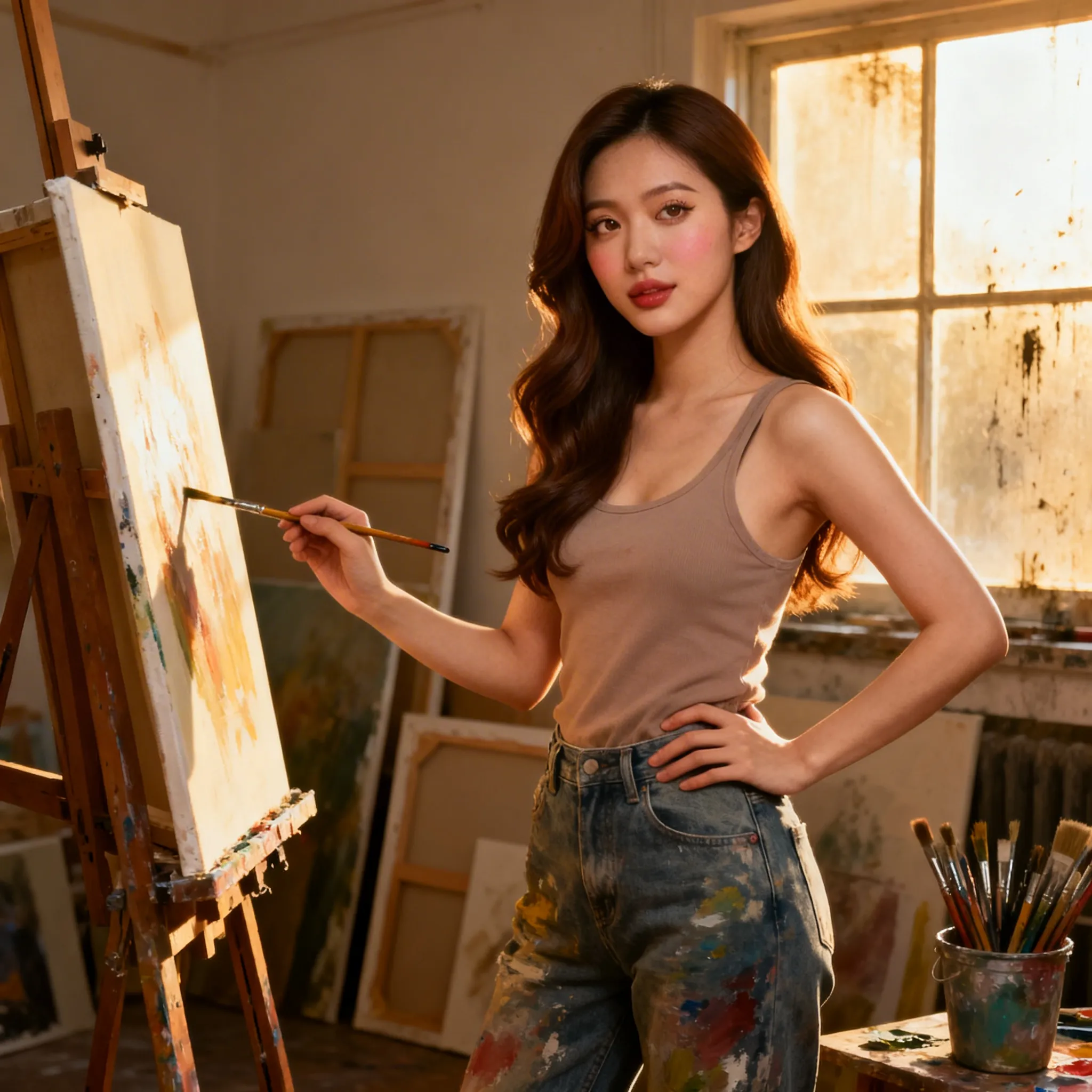
An environmental portrait that tells a story. She’s in her personal art studio. The space is creatively cluttered—canvases lean against walls, a small pot of brushes sits beside her, and sunlight streams through a large, slightly dirty window. She stands facing an easel, one hand on her hip, a paintbrush in the other, contemplating her work. She’s dressed in comfortable, paint-stained jeans and a tank top. The scene feels authentic, lived-in, and speaks volumes about her as a passionate, independent creator.
Advanced Tips for Pro-Level Scenes on Viyou AI
- Use Artistic & Cinematic References: Terms like cinematic lighting, environmental portrait, shot on 35mm film, or in the style of a lifestyle photoshoot can drastically elevate the output quality.
- Control Depth with Composition: Use shallow depth of field to blur the background and keep focus intensely on her. Use deep focus to showcase an elaborate environment.
- Balance is Key: Don’t let the scene overpower her. She should always be the focal point. If your scene description is longer than her character description, simplify it.
- Reuse and Evolve Her World: Once you design a perfect setting for her (e.g., “her bookshop”), revisit it in different moods—bright morning, rainy evening—to build a consistent, familiar world around her.
With these tools, you’re no longer just creating an image of a person. You’re creating a slice of a life—a life you can almost step into. The scene is the final, convincing detail that makes the fantasy feel tangible.