AI Video Generator
 AI Image to Video
 AI Text to Video
 AI Image Generator
 AI Image to Image
 AI Text to Image
 AI Video Generator
 AI Image Effects

 Bring your imagination to life with powerful Viyou AI tools.
 Contents
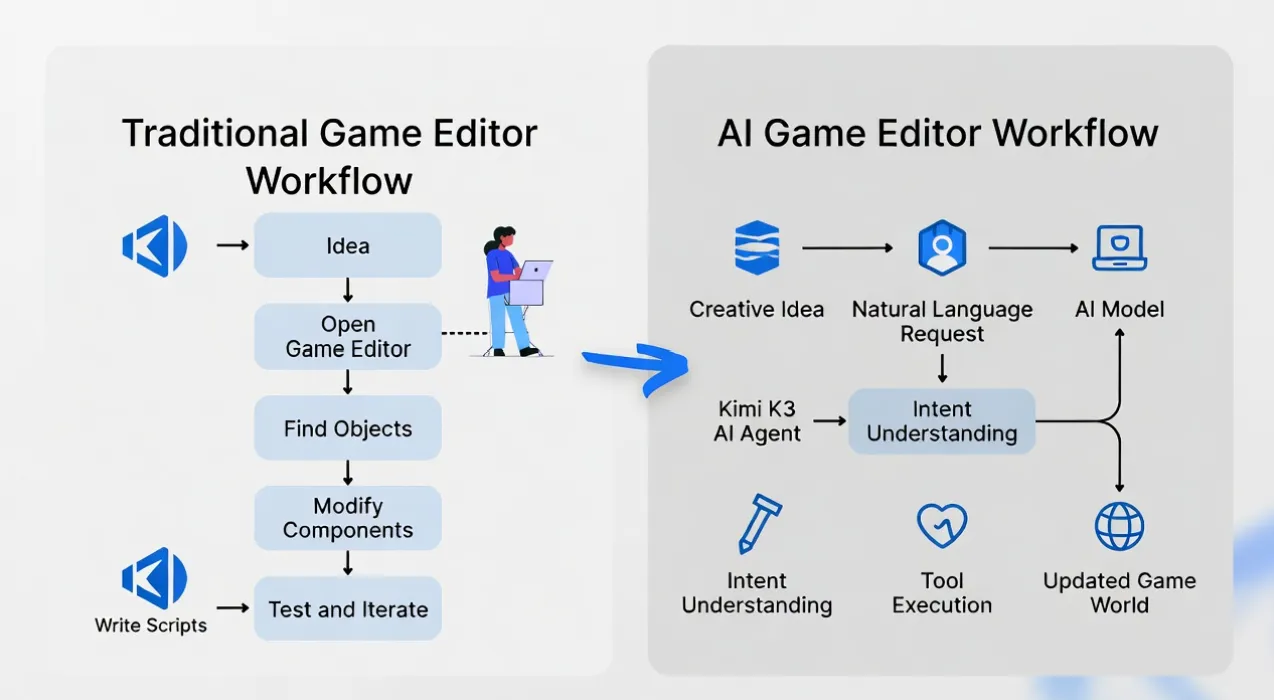
Game development has always relied on complex editing environments. Modern engines provide powerful tools for creating scenes, managing assets, configuring gameplay systems, and iterating on ideas. However, there is still a gap between what developers imagine and what they need to manually build inside the editor.A simple creative idea often needs to be translated into many technical operations.
For example, a developer may want to:
"Create a fantasy village with NPCs, interactive objects, and a quest system."
Inside a traditional workflow, this requires creating objects, assigning components, configuring behaviors, connecting assets, and writing gameplay logic.Large language models introduce a new possibility: using natural language as an interface for game creation.Instead of describing every technical step, developers can describe the result they want. An AI agent can interpret the intention, plan the required actions, and interact with the game editor through structured tools.This is the idea behind an AI Game Editor.Rather than replacing existing game engines, an AI Game Editor adds a new intelligence layer between developers and their creative tools.In this architecture, Kimi K3 can act as the reasoning engine that transforms natural language instructions into structured game editing operations.
This is a video introduction about the Kimi K3. You can click the link to learn more about it.
Why AI Game Editing Is Different from AI Coding
AI coding assistants are already changing software development. They can generate functions, explain code, and help developers solve programming problems.However, editing a game world requires a different level of understanding.A game is not only a collection of scripts. It is a connected system of scenes, objects, assets, behaviors, and player experiences.Consider a request:"Make the enemy stronger."A coding assistant might interpret this as increasing health points or attack damage.But a game editor needs to understand the intention behind the request.
A stronger enemy could mean:
- more health,
- smarter behavior,
- new abilities,
- different attack patterns,
The correct implementation depends on the context of the game.This is why AI Game Editors require more than code generation. They need to understand the relationship between technical changes and gameplay outcomes.The core challenge is not simply producing commands. It is translating human intent into meaningful changes inside a dynamic game environment.
The Architecture: Kimi K3 as the Reasoning Layer
A practical AI Game Editor should not allow a language model to directly modify every internal file in a project.Game projects contain complex dependencies between scenes, assets, scripts, and components. Direct file manipulation can easily create unexpected problems.A more reliable approach is to introduce an editor tool layer between the AI model and the game engine.
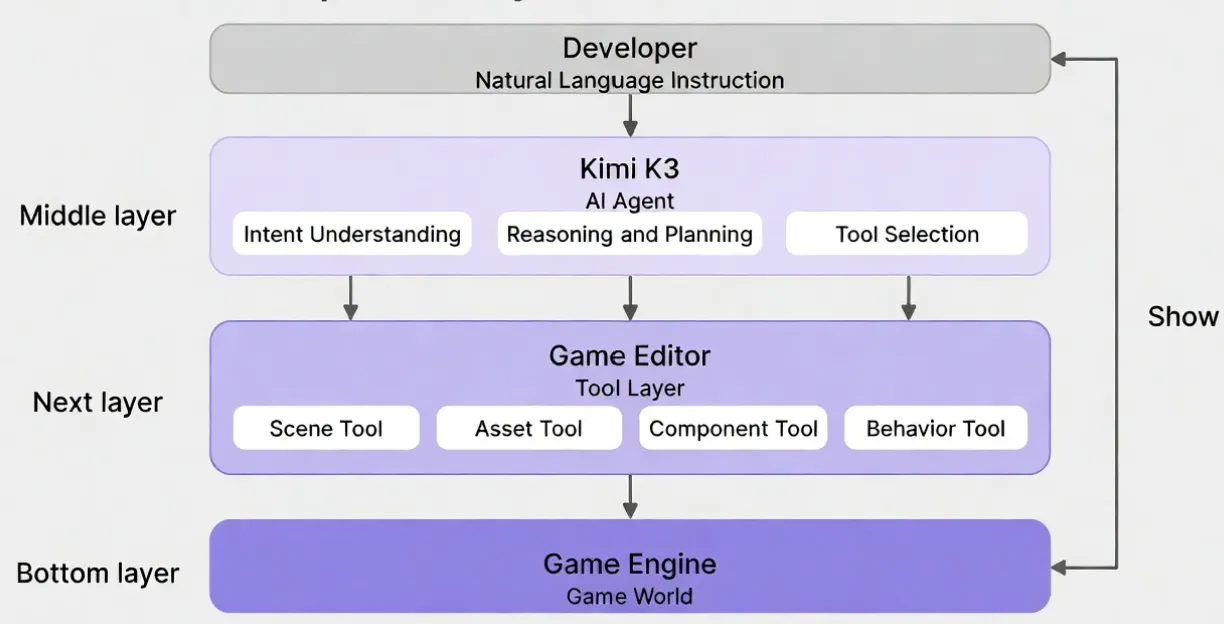
The key design principle is the separation between reasoning and execution.Kimi K3 is responsible for understanding the request, maintaining context, and deciding what actions are required.The editor tools handle the actual operations.For example, instead of asking the model to modify serialized scene files directly, the system can provide higher-level functions:CreateObject、ModifyComponent、ChangeEnvironment、AddGameplayBehavior.
This approach allows the AI to work with concepts closer to game development instead of low-level implementation details.The model decides what should happen. The editor controls how it happens.
From Natural Language to Game World Editing
The most important capability of an AI Game Editor is converting a high-level idea into a sequence of concrete actions.Imagine a developer writes:"Transform this forest into a winter environment."A human designer understands that this request involves multiple changes.The AI needs to analyze the current scene and determine what elements contribute to the environment.
The process may include:
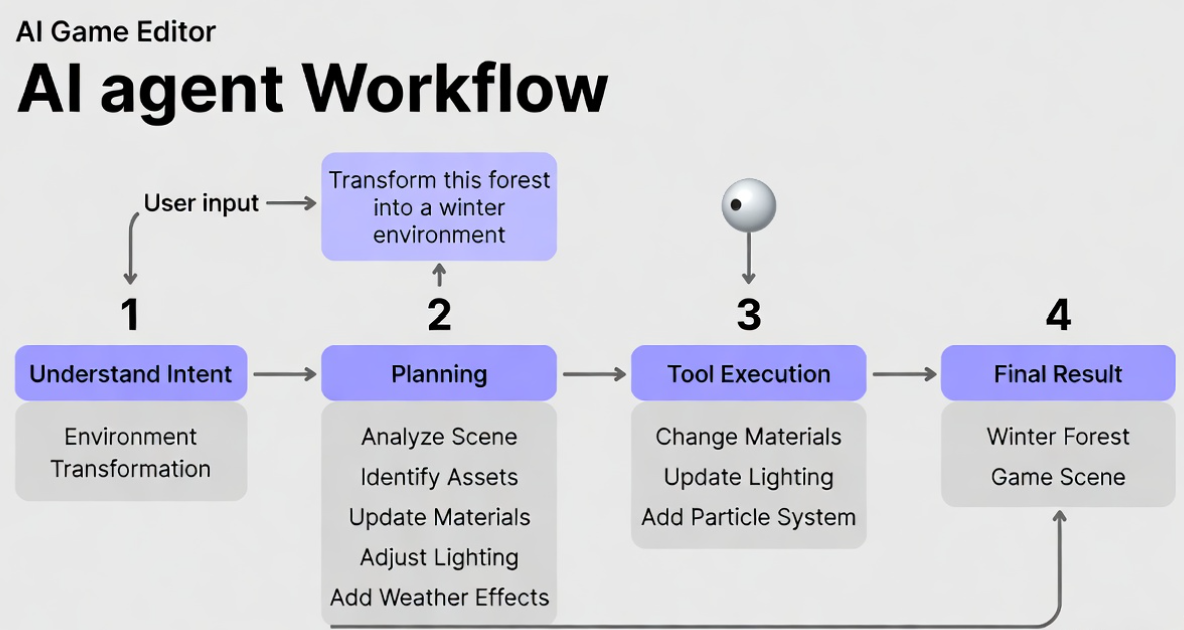
The actual modifications could involve terrain materials, vegetation appearance, lighting settings, weather effects, and particle systems.The important part is not executing each individual change.The important part is understanding that these changes belong together as one creative intention.A useful AI Game Editor needs to understand the relationship between different editing operations.
Why Tool Design Matters
A powerful language model alone is not enough to build an effective AI Game Editor.The tools exposed to the model determine how well it can interact with the game engine.
A low-level interface might expose operations like:Modify property value、Update object reference、Change serialized data
Although technically possible, this forces the AI to reason about engine internals.A better approach is to provide higher-level game-oriented tools:Create NPC、Change Environment、Add Interaction、Modify Character Behavior
The difference is important.When tools match the way developers think about game creation, AI agents can operate at a higher level of abstraction.This principle applies beyond game development:The quality of an AI agent depends not only on the intelligence of the model, but also on the design of the tools it can use.
Technical Challenges Ahead
Building an AI Game Editor involves several difficult engineering problems.These challenges show that an AI Game Editor is not simply a language model connected to a game engine.It is a complete system combining reasoning, tools, context management, and validation.
- The first is project understanding.Large game projects contain thousands of interconnected elements. An AI system needs efficient ways to retrieve relevant context and understand relationships between objects, assets, and gameplay systems.
- The second is maintaining control.Game development requires precision. Developers need the ability to review changes, define boundaries, and ensure that AI-generated modifications match their intention.
- The third is understanding creative goals.A technically correct modification does not always create a better game. AI systems need deeper understanding of gameplay design, visual consistency, and player experience.
Conclusion: Natural Language as a New Game Development Interface
The future of AI Game Editors is not about replacing traditional engines or removing developers from the creative process.Instead, it is about creating a more natural way to interact with game development systems.Developers may continue using scenes, assets, scripts, and components, but the interaction model could change from manual operations to intent-driven creation.With Kimi K3 acting as the reasoning layer, AI Game Editors represent a new approach to connecting human creativity with game engine capabilities.The biggest change may not be that AI writes more code. It may be that developers can communicate ideas directly to the systems that turn those ideas into interactive worlds.